
Booth space is the single most expensive way to reach a trade show audience, and it is priced that way because organizers know you have no obvious alternative.
You do have one. Geofencing reaches the same people standing in the same building, and it does not require floor space, a sponsorship tier, or the organizer's permission.
This is how to run it properly, including the part most people get wrong and the rules you should actually know about.
Why the booth math is worse than it looks
The floor space is the smallest line item. Once you add build and design, shipping and drayage, electrical, internet, carpet, staff travel and hotel at event rates, plus the days of selling those people are not doing, a modest booth becomes a serious commitment.
Then consider what you get. Foot traffic past your position, which depends heavily on where the organizer placed you, and conversations with whoever chooses to stop. Attendees who never walk your aisle are invisible to you.
A geofence does not care about aisle position. It reaches devices anywhere inside the boundary, including the people who never came near where your booth would have been.
None of which means booths are worthless. They are how you get real conversations, and there is no digital substitute for a demo across a table. The argument is narrower: if you cannot justify a booth this year, that is not the same as being unable to reach the audience.
One show, three campaigns
Here is the part most people get wrong. They think of a trade show as three days, so they run three days of ads. The show is a moment, but the opportunity is a window that opens weeks before and closes months after.
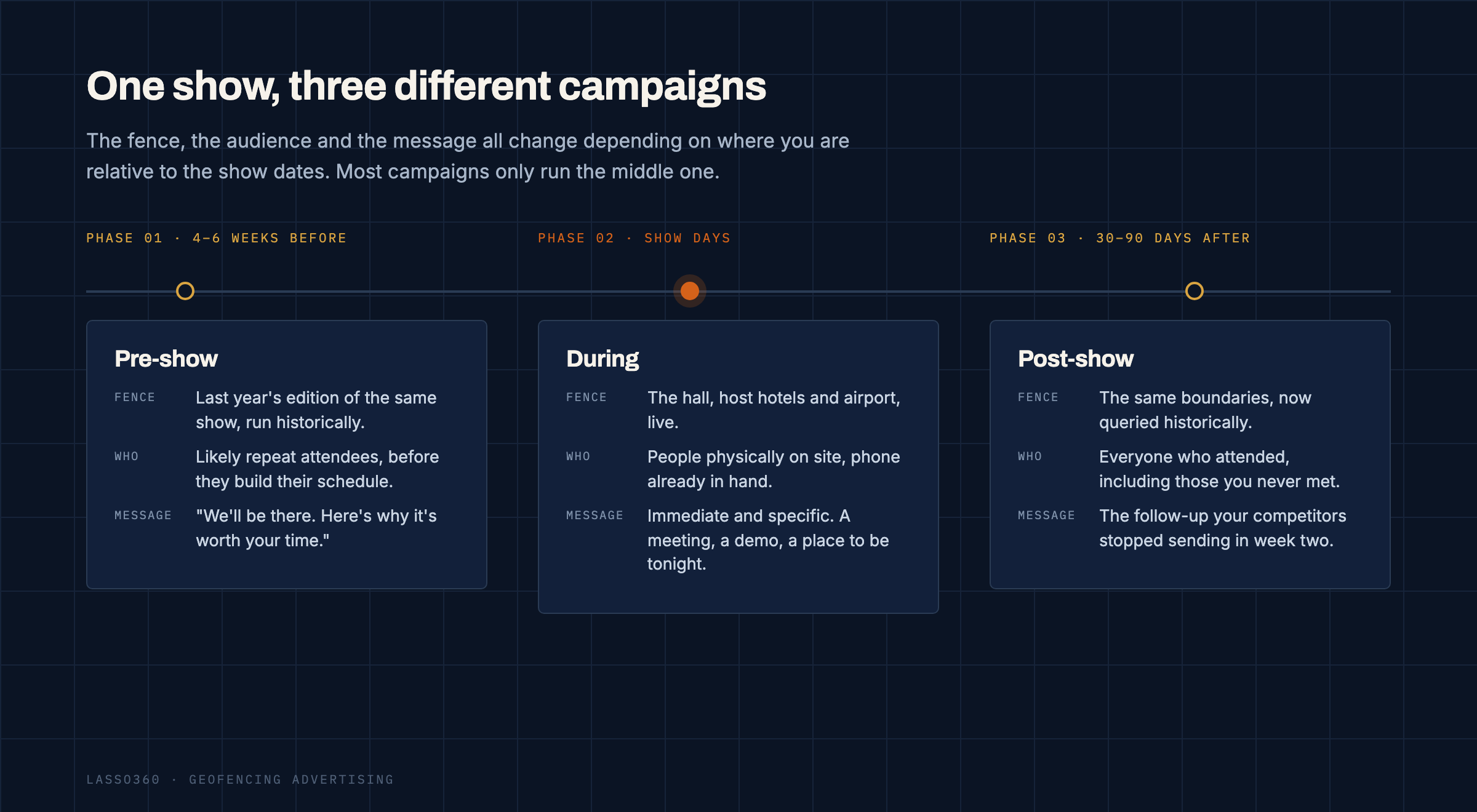
Pre-show, four to six weeks out. Fence last year's edition of the same show and run it historically. That audience is heavily weighted toward people who attend every year, and you are reaching them while their schedule is still open. Almost nobody does this. The message is simple: we will be there, here is why it is worth your time.
During the show. Fence the hall, the host hotels and the airport, live. These people are on site with their phones out and dead time between sessions. The message has to be immediate and specific. A meeting, a demo, a place to be tonight. Anything vague is wasted here.
Post-show, thirty to ninety days out. Query the same boundaries historically and keep going. This is the highest-value phase and the most neglected. Your competitors sent two follow-up emails and stopped. Meanwhile the actual buying decision is happening in week six, and the audience includes everyone who attended, not just the people who scanned a badge.
If you only have budget for one phase, run the third.
What to fence
Resist the instinct to draw one giant boundary around the convention center.
Convention centers are enormous, often attached to hotels, malls or transit, and they routinely host several events at once. A boundary around the entire building catches your audience plus a lot of people who happened to be in the neighborhood.
Tighter boundaries with better intent usually sit around the edges: the specific hall your show occupies, the official host hotels, the overflow hotels nobody else bothers with, and airport terminals narrowed to arrival and departure days. Several precise fences beat one enormous one nearly every time. There is more detail on that in the piece on advertising to people who attended a conference that already happened.
Is this against the rules?
Worth addressing honestly, because people ask and most articles avoid it.
Trade show organizers do have rules about non-exhibitors marketing to attendees. The terms you will see are suitcasing, meaning working the floor to solicit business without paying to exhibit, and outboarding, meaning running your own competing event at a nearby venue during show dates. Organizers enforce both, sometimes aggressively, and they can remove you.
Those rules govern physical presence and private events. Serving digital ads to people who happen to be in a geographic area is a different thing, and it is generally outside what exhibitor agreements cover. You are buying programmatic inventory, not floor access.
Two caveats worth taking seriously.
If you are an exhibitor or sponsor, read your contract. Some agreements include marketing exclusivity clauses that reach further than you would expect.
And keep the creative honest. Advertising near an event is normal. Implying you are an official sponsor, an exhibitor, or affiliated with the organizer when you are not is a different matter, and it will damage a relationship you probably need.
The distinction is simple: reaching the audience is fair game, misrepresenting your relationship to the event is not.
What decides whether it works
Fence precision. A boundary traced to the actual hall performs very differently from a radius dropped on a pin. This is the difference between a campaign and a waste of money, and it is invisible in the reporting until you compare fences.
Message that matches the phase. The three phases above are not the same campaign with different dates. Someone who has not chosen their schedule yet and someone standing on the floor at 2pm need different things.
Enough runway. Nobody converts from one impression at a trade show. Plan for sixty to ninety days on the back end, with a sequence rather than one creative repeated to exhaustion.
Frequency caps. The audience is finite and small. Without caps you will serve the same person the same ad dozens of times.
When to skip it
The show is too small. A fence needs enough device volume to be worth running. A few hundred people in a hotel ballroom often will not produce a usable audience, and no budget fixes that. Get a device count estimate before committing.
The venue is stacked vertically. One floor of a downtown convention hotel means your boundary catches the floors above and below. Sometimes fine, sometimes fatal.
The event is virtual. No location, no fence.
You need to know who attended. Geofencing reaches an anonymous group. If your plan depends on names, this is the wrong tool.
Where to start
Pick one show you would have exhibited at and did not. Draw the hall, add the host hotels, and pull a device count for last year's dates before you spend anything.
If the volume is there, you have a way to reach that audience for materially less than floor space. If it is not, you learned that from an estimate instead of a post-event report.
More on how the boundaries are drawn and measured: geofencing advertising and conference and event marketing.