
Every event marketer has had this conversation. A competing conference wrapped up last spring. Twelve hundred people who are exactly your audience spent three days in one building, and you had nothing running. The badges are collected, the hall is empty, and the opportunity feels gone.
It isn't. You can still advertise to those people.
The tactic is called historical geofencing, and it is the single most useful thing in event marketing that most organizers have never heard of. This is how it works and, more importantly, where it stops working.
What historical geofencing actually is
Standard geofencing draws a boundary around a location and reaches devices that are inside it right now. Useful during your own event, useless for one that already ended.
Historical geofencing does the same thing backwards. You draw the boundary, then select a date range in the past. The system returns the mobile advertising IDs of devices that were physically inside that boundary during those dates. Those devices become an audience you can serve ads to for weeks afterward.
You are not buying a list. You never receive names, emails or phone numbers, and any vendor implying otherwise is describing something you should not buy. What you get is an anonymous pool of devices that demonstrably showed up at a specific place on a specific set of days.
For a conference, that is a remarkably clean signal. Nobody spends three days at an industry trade show by accident. Attendance is the qualification.
How far back you can reach
This is where expectations need setting.
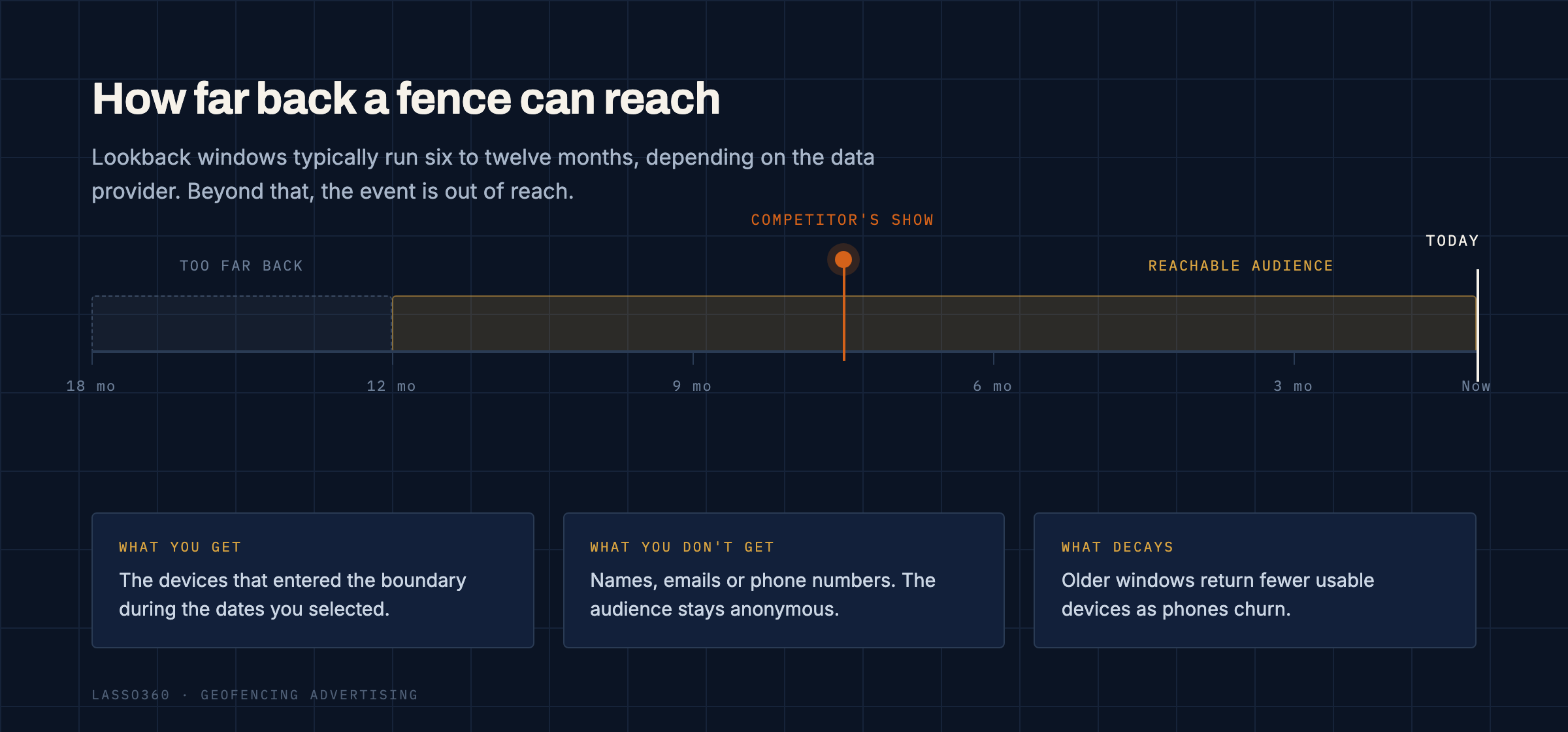
Lookback windows typically run six to twelve months, depending on the data provider. Some go further, most do not, and anyone promising two years is either using a different definition or overselling.
Two things decay as you reach further back. Device volume drops, because phones get replaced, ad IDs get reset and people opt out. And relevance drops, because a person's job, priorities and budget move on. An event from four months ago is a materially better audience than the same event fifteen months ago, even when both are technically reachable.
The practical rule: if a competing event happened within the last year, it is probably worth fencing. If it happened before that, spend the money somewhere else.
Fence more than the show floor
The instinct is to draw one boundary around the convention center and stop. That is usually the worst-performing fence in the whole campaign.
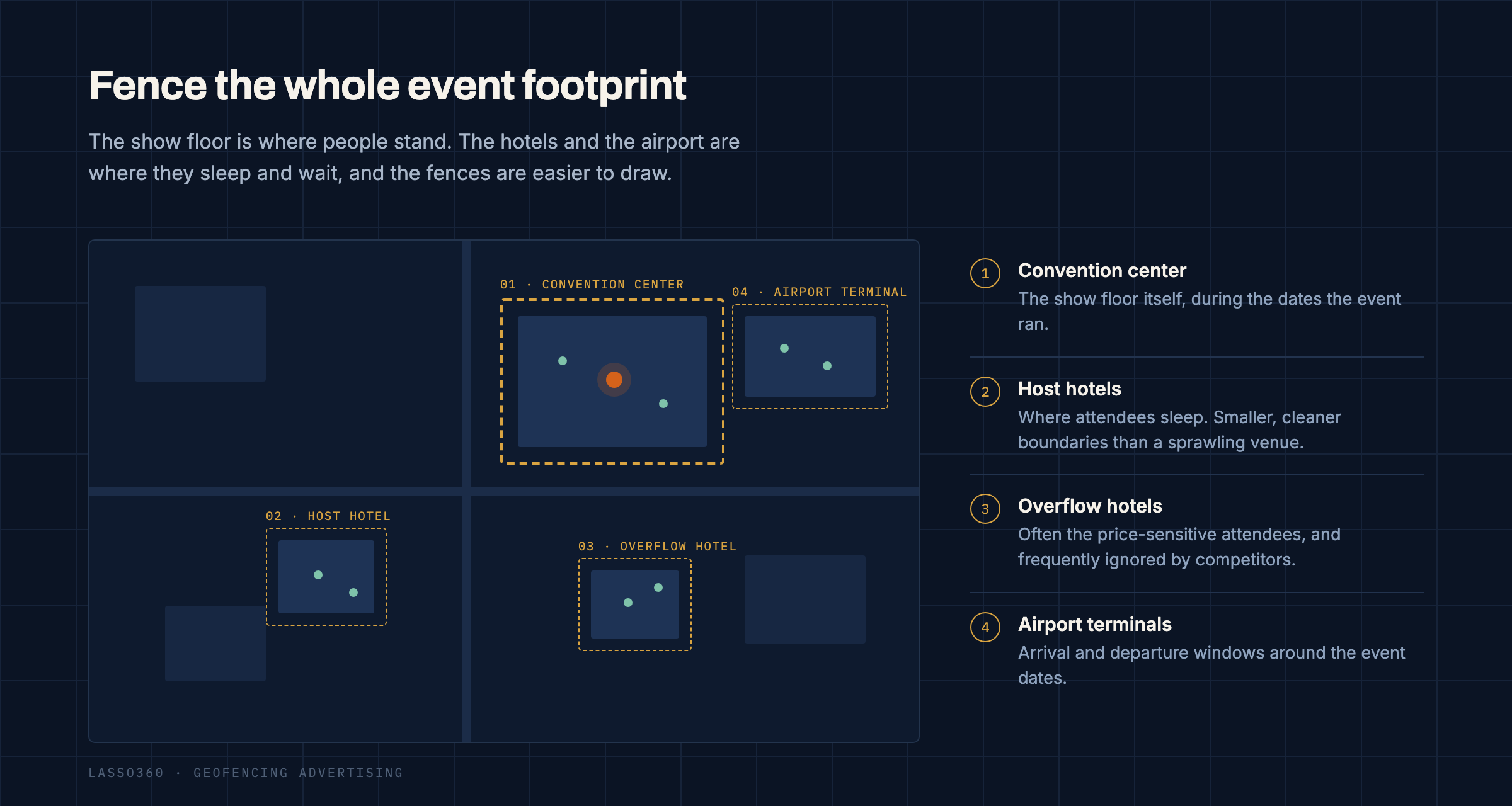
Convention centers are enormous, frequently attached to hotels, malls and transit, and they host multiple events at once. A boundary around the whole building catches your audience plus everyone who walked through for an unrelated reason.
Tighter, higher-intent boundaries usually sit around the edges:
- Host hotels. Where attendees sleep. Small, clean footprints, and during event dates the occupancy is overwhelmingly your target audience.
- Overflow hotels. Frequently the more price-sensitive attendees, and almost always ignored by competitors.
- Airport terminals, narrowed to arrival and departure days.
- The specific halls your audience would have been in, if the venue is large enough to distinguish them.
Several precise fences beat one enormous one nearly every time.
The part that actually determines results
Capturing the audience is the easy half. Most historical geofencing campaigns fail after this point, for reasons that have nothing to do with targeting.
The creative has to acknowledge reality. You are reaching someone weeks after an event, on a phone, mid-scroll, with no memory of you. An ad that says "register now" to a person who has no idea who you are is wasted impressions. The ones that work reference the shared context and offer something smaller than a purchase.
The landing page has to match the ad. Sending precisely targeted traffic to a generic homepage discards the entire advantage you just paid for. If the ad speaks to people who attended a specific kind of event, the page needs to continue that conversation.
The window has to be long enough. Nobody registers for a conference from one impression. Thirty day tests do not work here. Plan for sixty to ninety days of sustained presence, with a sequence rather than one creative repeated until everyone is sick of it.
Frequency needs a ceiling. The audience is finite. Without frequency caps you will show the same person the same ad forty times and turn interest into irritation.
Where it does not work
Some honest limits.
Small events. A fence needs enough device volume to be worth running. A 150 person regional meeting in a shared hotel ballroom often will not produce a usable audience, and no amount of budget fixes that. Get a device count estimate before committing.
Very dense venues. A conference on one floor of a downtown tower means your boundary catches the floors above and below. Sometimes acceptable, sometimes fatal, depending on what else is in the building.
Virtual and hybrid events. There is no location to fence. Obvious in hindsight, still gets asked.
Anything requiring individual identification. If your plan depends on knowing who attended, this is the wrong tool. Geofencing gives you reach into an anonymous group, not a contact list.
The compliance line
Geofencing is legal when run through legitimate data sources built on advertising IDs from users who accepted location sharing. That said, some locations should not be fenced regardless of legality: medical facilities, places of worship, schools, and anywhere the mere fact of a visit reveals something sensitive.
Conferences are generally uncomplicated. Medical and healthcare events deserve more thought, since attendance can imply a health condition rather than a profession. Judgment matters more than the letter of the rule.
Where to start
If you run an event and there is a competing show inside your last twelve months, that is the obvious first test. Draw the venue, add the host hotels, pull a device count, and see whether the audience is large enough to justify a budget before you commit to one.
If the numbers work, it is one of the few tactics in event marketing that reaches a genuinely pre-qualified audience without needing anyone's permission, badge scan or email address.
If they do not, better to learn that from an estimate than from a campaign report.
More on how the boundaries are drawn and measured: geofencing advertising and conference and event marketing.